Related links
 Homepage
 User documentation
 Uživatelská dokumentace
Framework Core functionality
- AyMINE Framework Server
- The AyMINE licence model
- FRM Module Releases
- Configuration of the user-defined fields
- Client-Defined attributes
- Server scripting & Automation
- Strings and translations
- User sessions
- Import collection of objects
- Multi tenant Architecture
- Export collection of objects
- System messaging
- System Rights
- File Management with End-to-End Encryption
- Server configuration for large files
SOA / Event Management
Support for Service Object Architecture and Internal Event ManagementModule - support for management
Front-End Scripting
System Management
- SaaS Management Module
- System Module Release Overiew
- Management of the SaaS service client
- Encryted wallet storing access keys for data vault
- Definition and Management users in the SaaS system
- Management of the system users
- System right management
- System role is how user administrator sets the rights
- File access, storing and locking
- Communication geateways
- Private Object Marks, Sign & Notes
Task Management Module
- About TSK module
- Support for voting and decision management
- Support and implementation notes for FMEA
- Support for the Methodology Management
- Project Methodology Support
- Project Roles - Data model and implementation notes
- Actions and Meeting Agenda
- Description of person and supplier competencies
- Business event
- Problem & Helpdesk management support
- TSK Module releases
- User Reminder
Task & Task pattern
Mobile & Web Application
- Client-Side Scripting using API
- Application Object Structure
- Clipborad Link - Cliplink
- fclip
- drag-drop
- AyMINE Application
- objectdefinition_inlineedit
- clientprogramming
- mobileapplication
- languagesupport
- objectdefinition_multiupdate
- Object API – object <g>
- clientprogramming_fevallanguage
- clientprogramming_fevaluser
- objectdefinition_viewdefinition
- offlineobjects
- System console
- Runtime debugging
- objectdefinition_detailview
CMS - Content Management & Web API services
FI - Finance Management
CRM Module Customer-Relationship Management technical & implementation notes
Sales & Asset management
Sales related services
Description of a part of the AM module - sales part Sales & Asset Management
Asset management module encapsulates everything that relates with products, assets, stocks. However, it also supports product description – analysis and documentation
 The sales management
 The Asset management
- Principal object model
- Why is Sales and Asset management in a single module
 Module dependencies and extensions
- User rights
The sales management
Principal sales management objects and relates business functionality supported by module are:
- Sales offer including AI for offer generation from email
- Sales order
- Price lists
The Asset management
The module supports evidences and processes related with
- Asset production, stocking and sales
- Trading /sales,
- Acquisition
- Procurement
- Stock management including management of the stock shelf positions and labelling positions and products with 2D / 1D barcodes
Module user documentation is here.
Asset management module is the optional module of the AyMINE Business Edition.
Principal object model
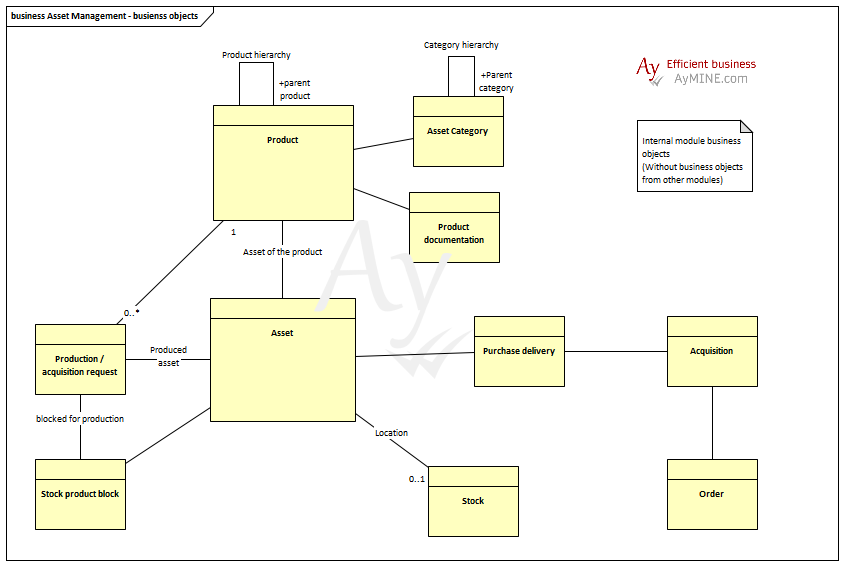
The following schema presents principal business objects:
Why is Sales and Asset management in a single module
Functionality of the sales management looks rather far from the asset management. Nevertheless, sales management is oriented trade-oriented and the trading companies have offer tightly related with traded products. Offer generation uses product catalogue and generates stock operations for order processing. All theses functions are tightly integrated in a single bundle of cooperating objects. Sales modules could not be used without the product catalogue.
Nevertheless, asset management is completely independent on the sales support and could be fully used without the sales support. Although the system rights are separated for both areas.
Module dependencies and extensions
Task management module
Module depends on the task management modules in many ways:
- Assets, product and categories relates to the business area and the area access-right-management is reused for assets products consistently with the task-management objects.
- Tasks are used for management of operations related with the assets.
CRM – Customer-relationship module
CRM modules provides address books and contact management. This functionality is used in the Asset Management module:
- Suppliers are companies / subjects from the CRM address book
- Supplier evaluation and supplier evidence is made in the CRM views and reuse the CRM functionality. (Company can have different address book for suppliers and the evidence could be totally separated from the sales and other contacts.)
Finance
Finance module manages information about all currency flows. Although assets internally store price data (actual and purchase cost) objects liked with financial flows are managed by the financial module
- Invoice
- Advance invoice
- Payment
- Payment return
Finance business objects are included in the data models although they are from different module.